What Is Cellulite, and Can You Actually Get Rid of It?
What Is Cellulite, and Can You Actually Get Rid of It?
I’ve had more patients apologize to me about their cellulite than about almost anything else. Women who run marathons, women who eat well, women who have put serious effort into their bodies for years. They show me the back of their thighs like they owe me an explanation.
They don’t. And neither do you.
Cellulite is not a weight problem. It is not a fitness problem. It is not a cleanliness or self-care problem. It is a structural problem. And understanding that distinction is what separates the treatments that work from the very long list of things that don’t.
What Cellulite Actually Is
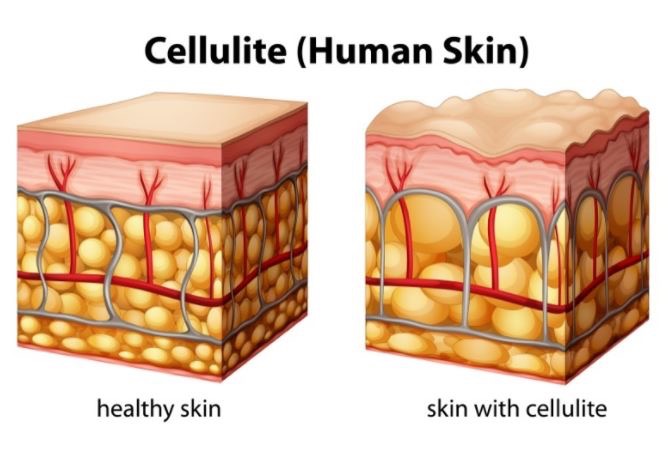
Cellulite forms because of the way fat is held in place beneath the skin. In women, connective tissue bands called fibrous septae run vertically between the skin and the muscle below, like columns in a building. When fat cells expand or these bands thicken and stiffen, they pull down on the skin while the fat pushes up. The result is the dimpled, uneven texture you see on the surface.
Men rarely get cellulite because their fibrous bands are arranged diagonally in a crosshatch pattern, which distributes pressure more evenly and doesn’t create that tethering effect.
This is why cellulite has almost nothing to do with how much fat you have. You can be lean and have significant dimpling. You can carry extra weight and have smooth skin. The deciding factor is how your connective tissue is arranged and how those bands behave over time.
It Runs in Your Family
Genetics explain more about cellulite than most people want to hear. If your mother has it, you are more likely to have it. Skin thickness, the number and arrangement of fibrous bands, and how your fat cells respond to hormonal changes are all heritable traits.
This doesn’t mean nothing can be done. It means that if you’ve been blaming yourself, you can stop. And it means that any treatment worth your time has to address the actual structure, not just the surface.
Why Creams Don’t Work
There is no topical product that removes cellulite. Not retinol. Not caffeine. Not anything with the word “firming” on the label.
Some creams temporarily improve the appearance of skin by increasing circulation or causing mild swelling that stretches the surface. A few minutes after you rinse off, you’re back where you started. Nothing in a jar penetrates deep enough to affect the fibrous bands tethering your skin from below. The mechanism isn’t there.
I’m not saying this to be harsh about products people have spent money on. I’m saying it because patients deserve to know the difference between something that makes skin feel smoother and something that changes what’s actually happening underneath.
What About Lasers?
Some laser and radiofrequency devices produce modest improvements in skin texture by stimulating collagen in the dermis. Devices like Thermage, Morpheus8, and others can tighten lax skin and improve overall tone. That has value.
But these devices are not cellulite treatments. They work from the outside in. Cellulite is caused by fibrous bands that physically tether the skin downward. No amount of external energy cuts those bands. The dimples remain because the underlying anatomy hasn’t changed.
Where devices like RF microneedling genuinely help is as a complement to mechanical treatment, particularly for improving skin quality after the structural work has been done. I think of it as part of a complete approach, not a standalone solution.
What Actually Works: Avéli
Avéli is the treatment I offer at ISA for cellulite, and it’s the one I’m most confident in.
It works differently than anything else on the market because it addresses the actual cause. During the procedure, a small handheld device is inserted through a tiny incision in the treatment area. It allows me to locate the specific fibrous bands responsible for each individual dimple and release them precisely. We’re treating the problem at its root, not layering something over it.
Avéli was FDA-cleared in 2022. Clinical data shows that 93% of treated dimples show improvement at 12 months. That kind of durability is what separates it from everything else in this category.
The procedure is done under local anesthesia in the office. Recovery is mild: some soreness and bruising for a week or two, compression garment worn for a short period afterward. Most patients are back to normal activity quickly. The results are not subtle improvements or improvements that require the right lighting. They’re visible, lasting changes to the actual texture of the skin.
I want to be direct about one thing: Avéli treats dimples caused by fibrous banding. It is not a fat reduction treatment. If fat volume is part of the picture, we’d talk about whether EmSculpt NEO or another approach belongs in the conversation. But for cellulite specifically, this is the most targeted, evidence-based option I’ve seen.
A Note on Who This Is For
Avéli is appropriate for women who have visible cellulite dimpling, typically on the thighs and buttocks, and who have not found improvement through lifestyle changes. It works across a range of body types and skin tones.
It is not a weight loss procedure and it is not right for everyone. We talk through your anatomy, your goals, and what realistic results look like during a consultation before any treatment is planned.
The Bottom Line
Cellulite is structural. The dimples you see are caused by fibrous bands pulling skin downward, not by something you ate or didn’t do in the gym. Creams can’t reach them. Most devices don’t cut them. Avéli does.
If you’ve lived with cellulite and assumed it was just something you’d have to accept, I want you to know that assumption is worth revisiting.
We offer Avéli at Intentional Self Aesthetics in New Canaan. If you’d like to understand whether it makes sense for you, I’d be glad to talk through it.
Teresa Alasio, MD is a board-certified physician in Pathology and Cytopathology and the founder of Intentional Self Aesthetics, a physician-led medical aesthetics practice in New Canaan, CT. She performs all treatments personally and writes a regular health column for the New Canaan Sentinel.